Architecture
Pandora (see Home) is a toolkit of plain functions and typed models that you combine as your dataset needs. The data those functions pass around is what actually defines the library's shape. This page has two parts: a table mapping each component's functions to the models they take and return, then entity-relationship diagrams showing how those models reference each other. The diagrams are generated straight from the models' type hints via erdantic, so they can never drift from the code. Regenerate them after changing a model:
For per-field descriptions, see Schemas; for full signatures and docstrings, see Functions.
Functions and the models they move
Every function below is pure: it takes a Structure (or another typed
model) in and returns a new one, never mutating its input. Types are
narrowed for readability — optional/keyword arguments and provenance-only
parameters are omitted; follow a function's link in
Functions for the exact signature. Every
pandora <subcommand> in the CLI wraps exactly one function below,
reading/writing the same types as files instead of in-memory objects — see
Library vs. CLI.
Ingestion
| Function | Takes | Returns |
|---|---|---|
fetch_mmcif() |
entry_id, provider, output_dir |
IngestionProvenance — writes the mmCIF file as a side effect |
fetch_list_mmcif() |
a list of entry_ids |
list[IngestionProvenance] — calls fetch_mmcif() once per id |
ingest_local_mmcif() |
path to a file already on disk |
IngestionProvenance — describes it without fetching/copying |
load_policy() |
path to a policy YAML |
canonicalisationPolicy |
Parsing
| Function | Takes | Returns |
|---|---|---|
mmcif_to_structure() |
path_to_mmcif |
(Structure | None, DiagnosticBundle, ResultStatus) — the framework's central data model |
Canonicalisation
| Function | Takes | Returns |
|---|---|---|
canonicalise_structure() |
Structure, canonicalisationPolicy |
(Structure, CanonicalMappings, canonicalisationProvenance) |
filter_ligands() |
atoms, asym_units, entities, LigandRules |
(atoms, asym_units) filtered — one of canonicalise_structure()'s nine internal rule steps, also callable on its own |
Metadata
| Function | Takes | Returns |
|---|---|---|
collect_metadata() |
Structure |
MetadataRecord — entry/quality/taxonomy/entity/ligand/UniProt records, all source-backed |
collect_metadata() is a thin wrapper over the extract_*() functions in
pandora.metadata.mmcif (one per record type); call those directly if you
only need one piece. See Metadata.
Annotations
| Function | Takes | Returns |
|---|---|---|
annotate_structure_counts() |
Structure |
AnnotationLayer (type="structure_counts") |
annotate_ligand_contacts() |
Structure |
AnnotationLayer (type="ligand_contacts") |
annotate_chain_interfaces() |
Structure |
AnnotationLayer (type="chain_interfaces") |
annotate_pairwise_sequence_identity() |
two Structures |
AnnotationLayer (type="pairwise_sequence_identity") |
Every annotate_*() function returns the same AnnotationLayer envelope
regardless of what it computed — layer.data is where the shape actually
differs; see Annotation for each one's data schema.
Datasets
| Function | Takes | Returns |
|---|---|---|
curate_structure() |
Structure, MetadataRecord | None, DatasetCurationPolicy |
(Structure | None, list[ExclusionRecord], CurationProvenance) — None structure means excluded; records also cover removed chains |
chain_completeness() |
Structure, MissingResidueDefinition |
(list[ChainCompleteness], DiagnosticBundle) |
deduplicate_structures() |
list[Structure], DeduplicationRules |
(list[Structure], list[ExclusionRecord], DeduplicationProvenance) |
extract_chain_records() |
Structure |
list[ChainRecord] |
extract_residue_records() |
Structure |
list[ResidueRecord] |
extract_interface_records() |
Structure |
list[InterfaceRecord] — reshapes annotate_chain_interfaces()'s output |
entry_sequences() |
dict[str, Structure] |
dict[str, str] — one representative sequence per entry, feeds compute_sequence_similarity() |
Similarity
| Function | Takes | Returns |
|---|---|---|
compute_sequence_similarity() |
sequences (dict[str, str], list[ChainRecord], or a FASTA directory), hits_path |
SimilaritySearch — MMseqs2's hit TSV kept at hits_path |
compute_structure_similarity() |
structure file paths, hits_path |
SimilaritySearch — Foldseek's hit TSV kept at hits_path |
load_similarity_search() |
an existing hit TSV, engine |
SimilaritySearch (origin="precomputed") |
iter_edges() |
SimilaritySearch, HitFilter |
Iterator[Edge] — streamed, filtered hit rows |
cluster_edges() |
item_ids, any iterable of (id, id) pairs |
(list[SimilarityCluster], ClusteringProvenance) |
cluster_similar_items() |
item_ids, SimilaritySearch, HitFilter |
(list[SimilarityCluster], ClusteringProvenance) — streams iter_edges() into cluster_edges() |
partition_dataset() |
list[SimilarityCluster] |
(dict[str, list[str]], PartitionProvenance) — the train/val/test split, whole clusters per side |
Provenance
| Function | Takes | Returns |
|---|---|---|
build_provenance_bundle() |
one Structure + whatever ingestion/canonicalisation/metadata/annotation provenance you already have |
ProvenanceBundle |
build_dataset_manifest() |
policies + every stage's provenance record above, plus a ProvenanceBundle per retained structure |
DatasetManifest |
reproduce_dataset() |
a DatasetManifest |
(dict[str, Structure], DatasetManifest) — replays every recorded step from just the manifest |
Export
| Function | Takes | Returns |
|---|---|---|
structure_to_mmcif() |
Structure |
an mmCIF file |
export_chain_mmcif() |
Structure, chain_id |
an mmCIF file with only that chain's atoms/connections |
write_json() |
any pydantic BaseModel (e.g. a DatasetManifest) |
a JSON file |
write_records() |
a Sequence[BaseModel] (e.g. list[ChainRecord]) |
a JSON or Parquet file |
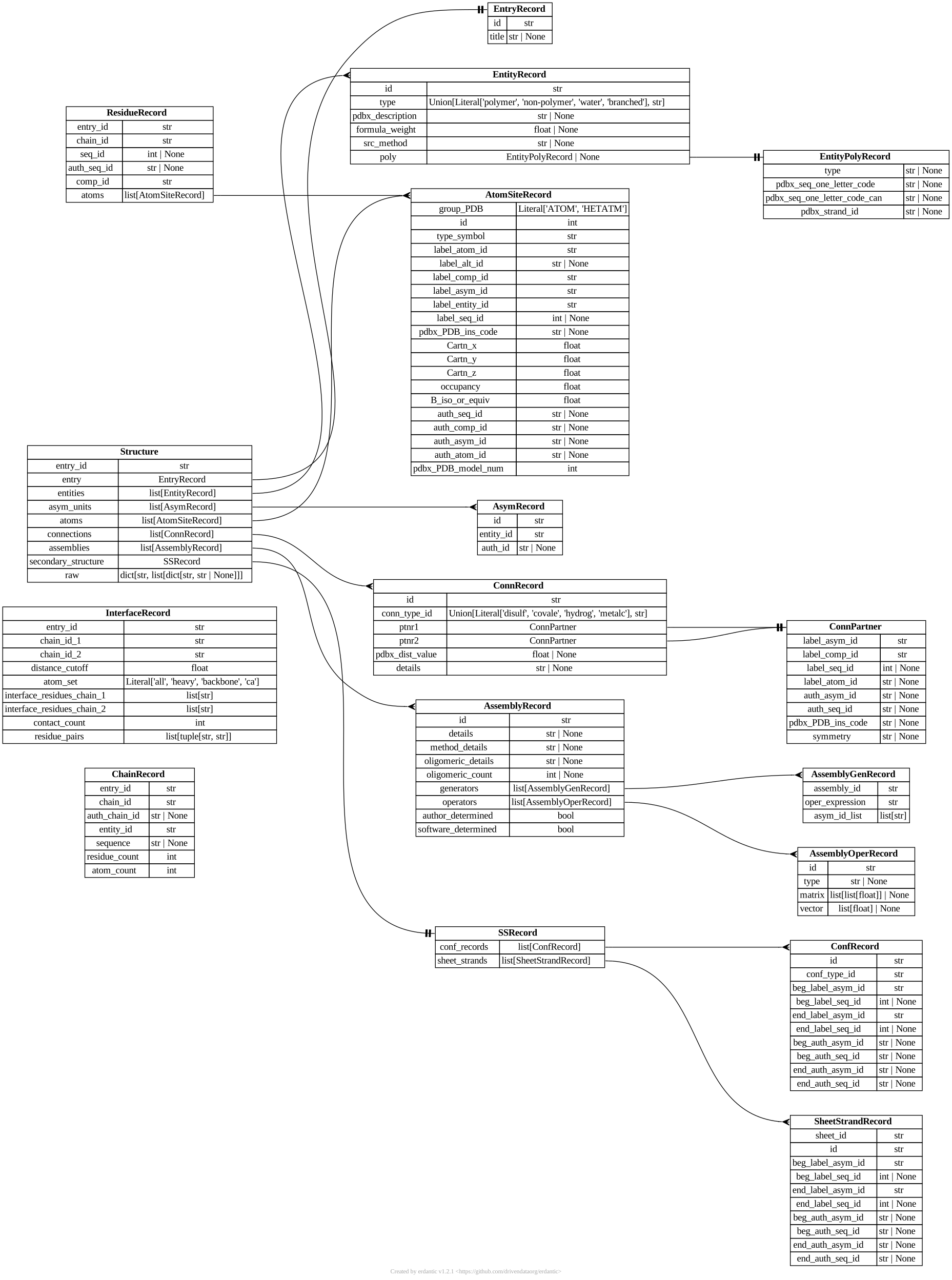
The parsed molecule
mmcif_to_structure() (pandora.parsing) turns a raw mmCIF file into a
Structure — the framework's central data model. Every later stage
(canonicalise_structure(), collect_metadata(), the annotate_*()
functions, structure_to_mmcif()) takes a Structure in and, where it
transforms one, returns a new Structure rather than mutating in place.
pandora.datasets.extract_*_records() reshapes a canonical Structure
into flatter, ML-friendlier views (ChainRecord, ResidueRecord,
InterfaceRecord) for export.
Canonicalisation policy
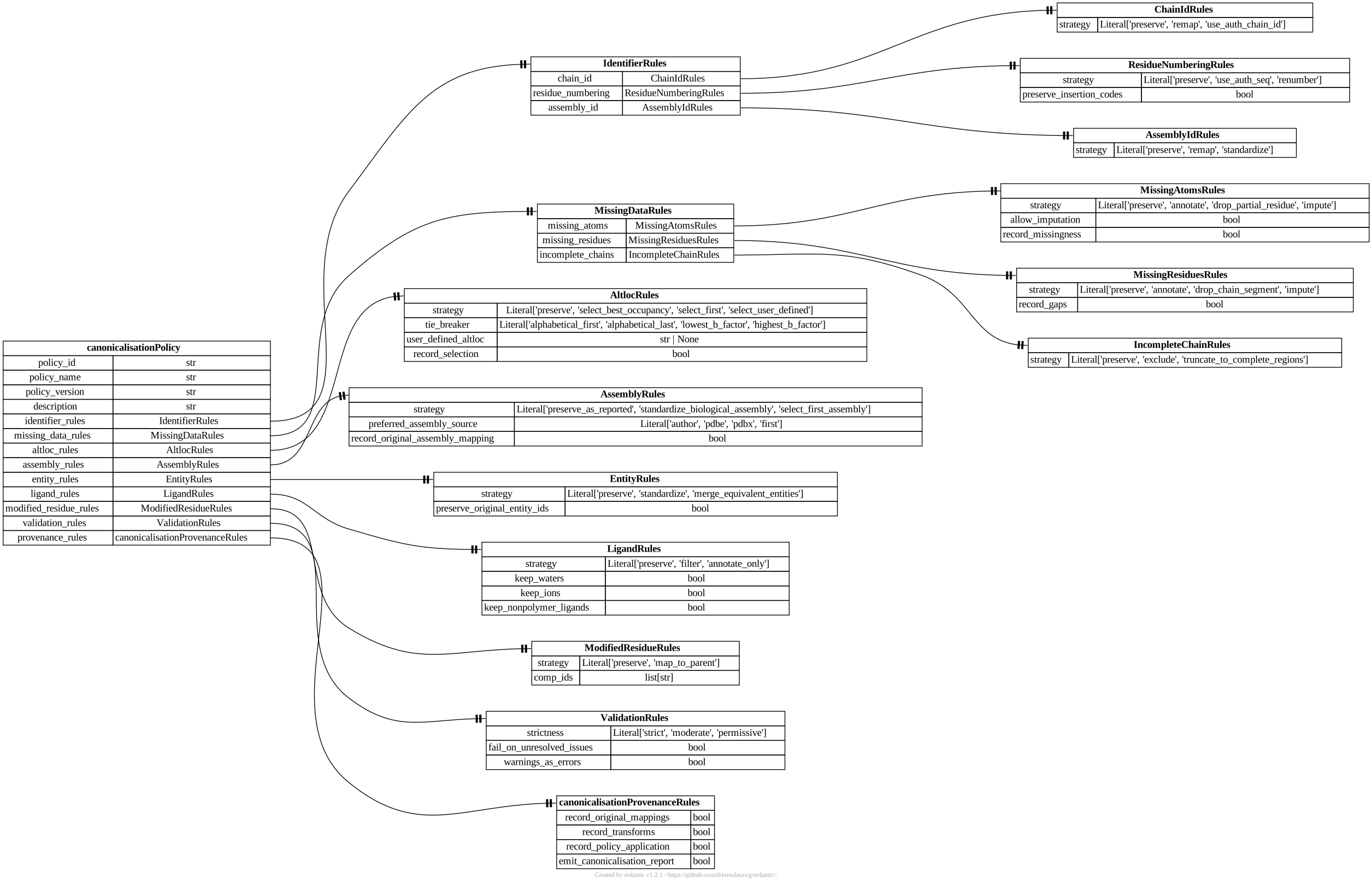
canonicalise_structure() runs nine rule groups in a fixed order — chain
IDs, residue numbering, assemblies, entities, missing data, altlocs,
ligands, then validation — each configured by one rules sub-model bundled
into a single canonicalisationPolicy. This tree is exactly what a
policy YAML file (see Policies) deserializes into.
Dataset curation policy
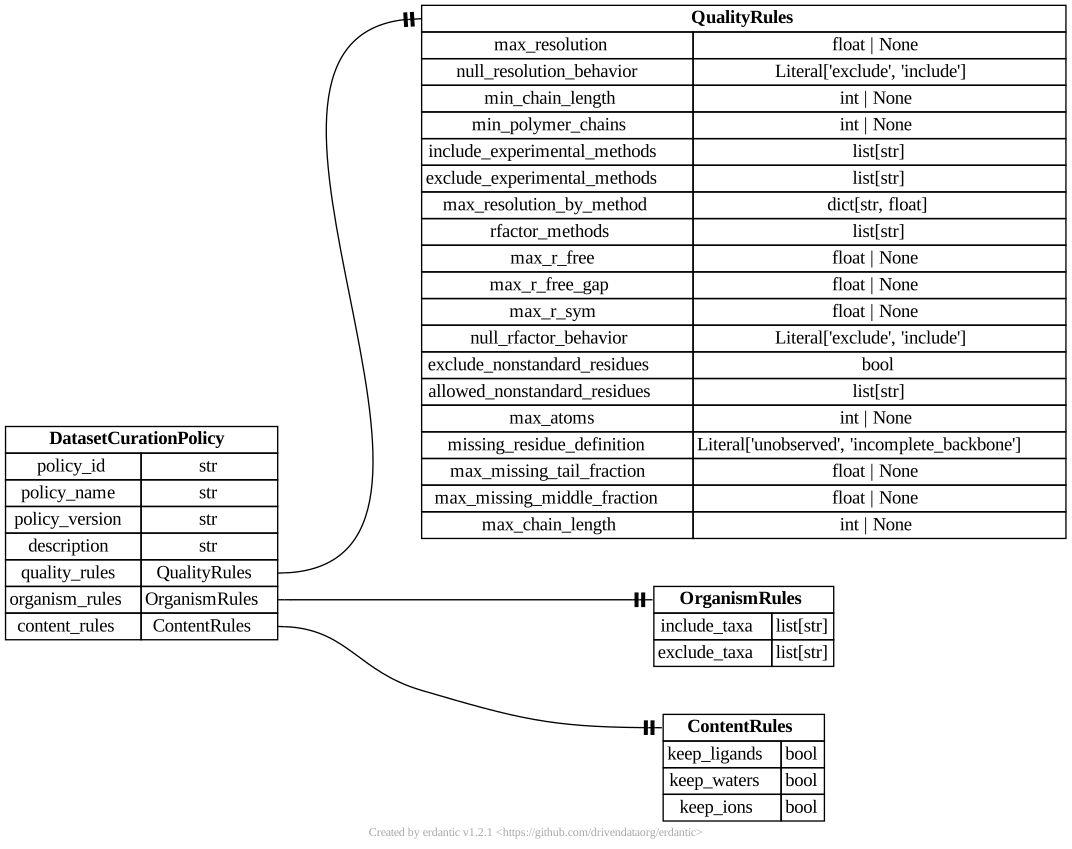
curate_structure() filters a canonical Structure by quality (resolution per method, R-factors, experimental method, residue content, size, missing residues, chain length), source organism, and non-polymer content — governed by a much smaller DatasetCurationPolicy. Chain rules remove failing chains rather than the whole entry.
Provenance and the dataset manifest
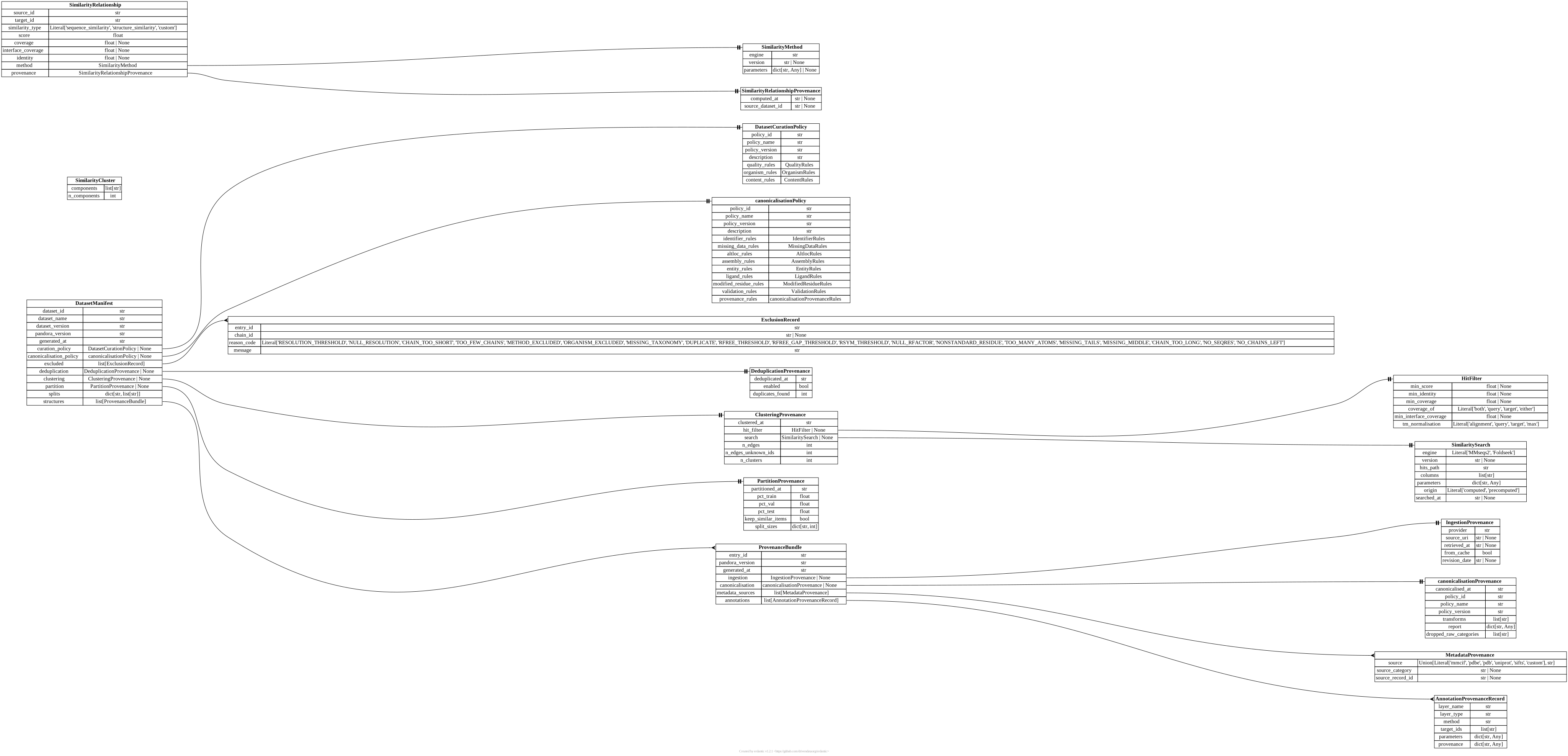
Every stage produces its own provenance record; build_provenance_bundle()
collects one structure's worth (ProvenanceBundle) and
build_dataset_manifest() aggregates dataset-wide provenance —
curation, deduplication, clustering, partitioning — plus every retained
structure's bundle into one DatasetManifest, the single JSON file that
reproduce_dataset() can later replay from. The canonicalisationPolicy
and DatasetCurationPolicy boxes below are the same models diagrammed
above, shown collapsed here to keep this diagram readable.
Standalone models
A few models aren't pictured because they don't reference — or get referenced by — any other schema:
AnnotationLayer(pandora.schemas.annotation) is the live result returned by eachannotate_*()function; only its lighter-weight siblingAnnotationProvenanceRecord(pictured above, underProvenanceBundle) gets persisted into a manifest.Diagnostic/DiagnosticBundle(pandora.schemas.common) carry parsing/canonicalisation warnings and errors; they're threaded through as function arguments, not stored on any other model.FetchOptions(pandora.schemas.ingestion) configures onefetch_mmcif()call and isn't retained afterward — only its result,IngestionProvenance, is.